

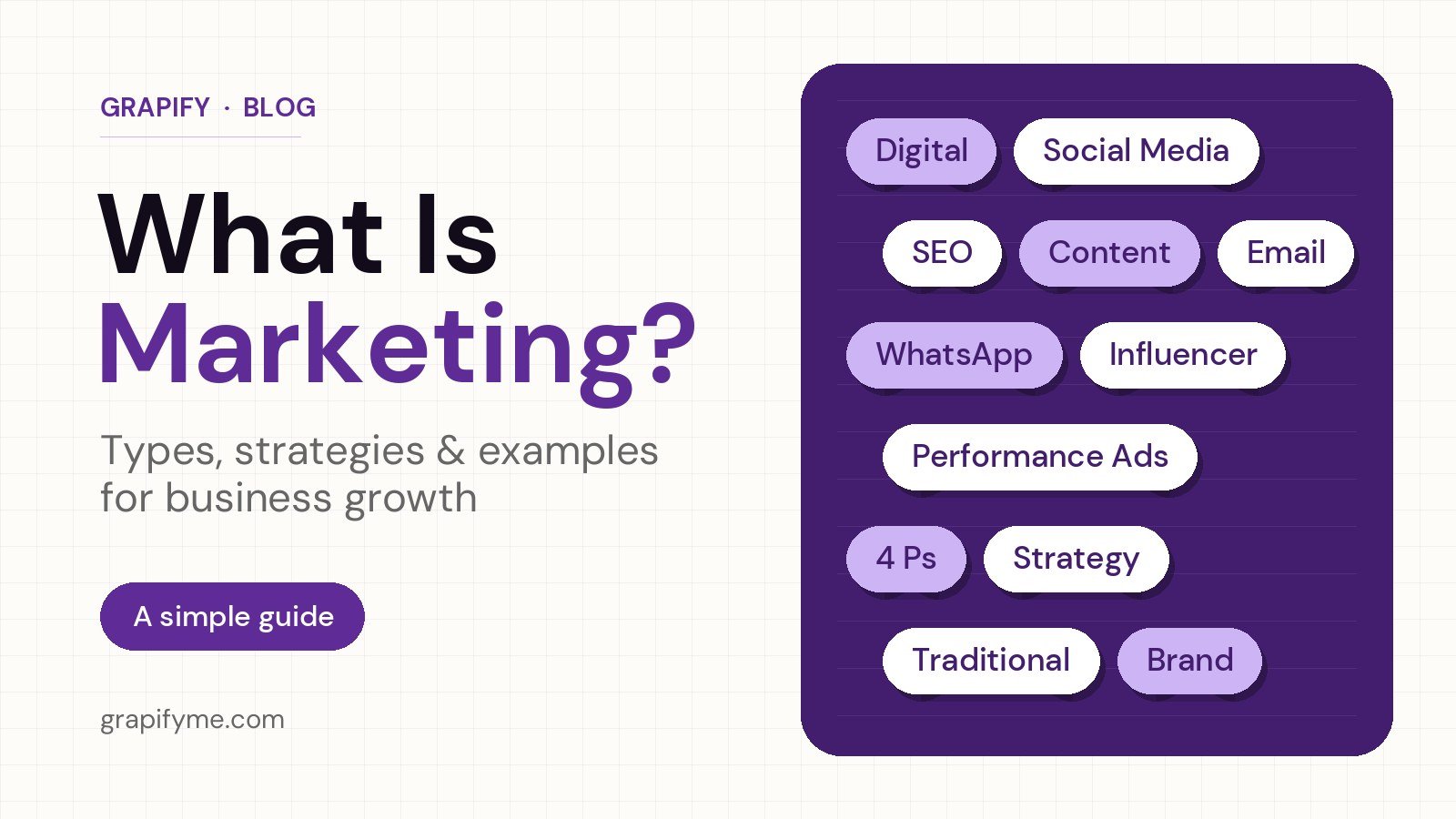
Marketing is everywhere. The reel you stop on while scrolling Instagram, the hoarding you pass on your way to work, the WhatsApp message from your favourite store about a new collection: each of these is part of someone’s marketing plan.
But marketing is much more than advertisements, offers or selling products. It is the process of understanding customers, finding out what they need, explaining the value you offer and building relationships that make people choose your brand again and again.
Whether you are a student learning the basics, a founder starting your first business or a business owner who wants to grow, this guide explains what marketing is, the main types of marketing, the 4 Ps, how to build a marketing strategy and how to choose what is right for your business.
What Is Marketing?
Marketing is the process of researching, promoting, communicating and delivering products or services to meet customer needs while achieving business goals.
It involves understanding your target audience, spotting market opportunities, creating offers people want and telling them clearly why they should choose your brand.
In simple terms, marketing is about connecting the right product with the right audience, through the right message, on the right platform.
For example, imagine a new clothing brand launching its first collection. Before it sells a single piece, it has to understand who its customers are, decide its prices, create a brand identity, make content and choose where to reach buyers: Instagram, a website, a marketplace or a store. All of these activities are marketing.
Marketing vs Advertising: What Is the Difference?
People often use the two words as if they mean the same thing, but they don’t. Marketing is the whole process: research, product, pricing, positioning, promotion and customer relationships. Advertising is one part of marketing. It is paid communication, such as a Google ad, an Instagram ad or a newspaper ad.
What Are the Main Objectives of Marketing?
Every marketing activity should have a clear purpose. Goals differ from business to business, but the most common objectives are:
1. Building brand awareness: making more people familiar with your business, products and brand identity.
2. Generating leads: attracting potential customers who are interested in what you offer.
3. Increasing sales and revenue: encouraging people to buy through well-planned campaigns.
4. Understanding customer needs: learning about customer behaviour, preferences and expectations so you can build better products and experiences.
5. Building customer relationships: creating trust and engagement that lead to repeat purchases and referrals.
What Are the Different Types of Marketing?
Marketing has changed a lot over the years. Today, businesses use different types of marketing depending on their goals, audience and budget. Here are the 10 most common types.
1. Digital Marketing
Digital marketing means promoting products, services and brands through digital channels such as websites, search engines, social media, email, WhatsApp and online ads. It helps businesses reach people online, generate leads and measure exactly how each campaign performs.
Important areas of digital marketing include:
- Search Engine Optimisation (SEO)
- Search Engine Marketing (SEM)
- Social media marketing
- Content marketing
- Email and WhatsApp marketing
- Performance marketing
- Affiliate marketing
Example: a business running Google Ads to reach people who are searching for its services is using digital marketing.
2. Social Media Marketing
Social media marketing uses platforms like Instagram, Facebook, LinkedIn, YouTube and Pinterest to promote a brand, talk to customers and build a community. It includes posts, reels, videos, stories, carousels and interactive content.
Businesses use social media marketing to:
- Increase brand visibility
- Build audience engagement
- Showcase products and services
- Generate leads
- Build a clear brand identity
Example: a restaurant posting food reels, customer moments and weekend offers on Instagram to attract people nearby.
3. Content Marketing
Content marketing focuses on creating useful, relevant content that attracts and engages a specific audience. Instead of selling directly, the aim is to educate, inform or entertain, so that people trust the brand when they are ready to buy.
Common content marketing formats include:
- Blog articles (like this one)
- Educational videos and reels
- Infographics
- Case studies
- E-books and guides
- Podcasts
- Social media content
Example: a skincare brand publishing blogs about skincare routines and ingredients to educate potential customers.
4. Search Engine Optimisation (SEO)
SEO is the process of improving a website’s visibility in Google’s free (organic) search results. It helps businesses get relevant visitors when people search for products, services or information related to their industry.
SEO has three main parts:
- On-page SEO: improving page content, headings, keywords and internal links.
- Off-page SEO: building your website’s authority through mentions and links from other trusted websites.
- Technical SEO: improving site structure, speed, crawling and indexing.
For local businesses, a complete and active Google Business Profile is also a big part of SEO, because it decides whether you show up on Google Maps when people search “near me”.
Example: a furniture showroom improving its website and Google Business Profile so it appears when someone searches “sofa shop near me”.
5. Search Engine Marketing (SEM)
Search Engine Marketing means promoting a website through paid ads on search engines like Google. Businesses bid on search terms so their ads appear in front of people who are actively looking for a product or service.
Example: a real estate company running Google Search Ads for people searching for apartments in Delhi.
6. Influencer Marketing
Influencer marketing means working with creators who already have a loyal audience to promote a brand, product or service. It helps brands reach the right people through a voice they already trust.
Example: a fashion brand collaborating with a fashion creator to show its new collection through Instagram reels.
7. Email Marketing
Email marketing uses emails to stay in touch with existing and potential customers. It is commonly used for newsletters, product updates, offers, welcome emails and bringing back old customers.
Example: an e-commerce brand sending personalised emails about new arrivals and exclusive discounts to its subscribers.
8. WhatsApp Marketing
In India, WhatsApp is often the fastest way to reach a customer. WhatsApp marketing uses the WhatsApp Business app or the WhatsApp Business API to share catalogues, answer enquiries, send order updates and share offers with customers who have agreed to hear from you.
It works especially well for local businesses, showrooms, D2C brands and service businesses, because customers can ask a question and get a reply in the same chat. Always message only people who have opted in. Sending unwanted messages hurts your brand and can get your number blocked.
Example: a home décor store sharing its new catalogue on WhatsApp with past customers and answering price questions directly in the chat.
Email and WhatsApp are both part of retention marketing: keeping existing customers coming back.
9. Performance Marketing
Performance marketing is a results-driven approach where campaigns are measured against clear outcomes, such as clicks, leads, app installs, purchases or conversions. It usually runs on paid platforms like Google Ads and Meta Ads (Facebook and Instagram).
Example: an online business running Instagram and Facebook ads to get website purchases and tracking the cost of each sale.
10. Traditional Marketing
Traditional marketing uses offline channels such as television, radio, newspapers, magazines, hoardings, brochures, pamphlets and direct mail. Digital platforms have changed marketing, but traditional marketing still helps reach certain audiences and build recognition, especially in local markets.
Example: a company launching a new product with a newspaper ad and a hoarding campaign in its city.
Understanding the 4 Ps of Marketing (The Marketing Mix)
The 4 Ps of marketing are the basic building blocks businesses use to plan their marketing and position their products. Together they are called the marketing mix.

1. Product
The product or service you offer to meet customer needs. This includes features, quality, design, packaging and the overall customer experience.
2. Price
The amount customers pay. Pricing depends on production costs, competition, what customers expect to pay and your business goals.
3. Place
The channels where customers can find and buy your product: physical stores, your website, e-commerce marketplaces like Amazon and Flipkart, and distributors.
4. Promotion
The activities you use to communicate your product’s value and attract customers, such as advertising, PR, social media, offers and content marketing.
What about the 7 Ps? Service businesses often add three more Ps: People (the team who serves the customer), Process (how the service is delivered) and Physical evidence (what customers can see and touch, like your office, website or packaging).
Traditional Marketing vs Digital Marketing
Both traditional and digital marketing aim to reach customers and promote a business, but they use different channels.
| Traditional Marketing | Digital Marketing |
|---|---|
| Newspapers and magazines | Blogs and websites |
| Television ads | YouTube ads and reels |
| Radio promotions | Podcasts and digital audio |
| Hoardings and banners | Social media ads |
| Printed brochures and pamphlets | Email and WhatsApp campaigns |
| Results are hard to track exactly | Every click, lead and sale can be tracked |
Traditional marketing is useful for broad offline visibility. Digital marketing offers more precise targeting, two-way engagement and measurable results. Many businesses combine both to reach customers at different points.
What Is a Marketing Strategy?
A marketing strategy is a planned approach that helps a business reach its target audience, communicate its value and achieve specific goals.
A good marketing strategy is not just about posting regularly or running ads. It needs research, planning, execution and constant improvement. Here are the key steps:
1. Market research: understand industry trends, customer expectations and opportunities.
2. Target audience: identify the people most likely to buy from you, including their age, city, interests and problems.
3. Competitor analysis: study what your competitors do well, how they position themselves and where they fall short.
4. Goal setting: set measurable goals such as brand awareness, website traffic, leads or sales.
5. Channel selection: choose the platforms your audience actually uses.
6. Content and campaign planning: plan the content, campaigns and messages for each channel.
7. Performance measurement: track engagement, website traffic, conversion rate and return on ad spend (ROAS), then improve what isn’t working.
How to Choose the Right Type of Marketing for Your Business
You don’t need to do every type of marketing at once. Most businesses grow faster by doing two or three things well than by doing ten things badly. Start with where your customers already are:
- Local shop, showroom, clinic or restaurant: start with a complete Google Business Profile, an active Instagram page with reels and WhatsApp for enquiries.
- Product or D2C brand: start with strong product photos and videos, social media, Meta ads and a website or marketplace store where people can buy. See our marketplace and D2C service.
- B2B or service business: focus on a professional website, SEO, LinkedIn, case studies and email.
- New brand: get the basics right first: a clear brand identity, a simple website and consistent social media. Paid ads work much better once these are in place.
Whatever you choose, track the results every month and put more effort into what brings real enquiries and sales.
Marketing in Action: Examples From Our Work
Here is how different types of marketing come together for real brands we have worked with at Grapify:
- Reindeer Seating Collection (furniture): a furniture brand built from a blank page: brand identity, catalogues, website, product shoots, reels and Meta ads, all working together.
- Dynamic Architect (architecture and interiors): project shoots and AI-edited reels that put the firm’s finished spaces in front of people looking for an architect.
- Vantage (bathroom fittings): a bath brand taken online from zero, with a website to shop, a price list catalogue, brand videos and influencer campaigns.
Each brand needed a different mix. That’s the key lesson: the right marketing depends on your product, your customers and your goals.
Why Is Marketing Important for Business Growth?
Even a great product or service needs visibility to reach customers. Here is how marketing helps a business grow:
- Increases brand awareness: helps more people discover and remember your business.
- Attracts potential customers: connects your products and services with the right audience.
- Builds credibility: consistent communication and useful content build trust.
- Improves customer engagement: gives you more chances to talk with your audience.
- Supports expansion: helps you enter new cities, markets and customer segments.
- Encourages repeat business: keeps existing customers coming back.
A well-planned marketing strategy helps a business move beyond simply selling products and build a brand people recognise and trust.
Frequently Asked Questions About Marketing
1. What is marketing in simple words?
Marketing is everything a business does to understand its customers, create something they want, tell them about it and keep them coming back.
2. What are the 4 Ps of marketing?
The 4 Ps of marketing are Product, Price, Place and Promotion. Together they form the marketing mix and help businesses plan how to offer and promote their products or services.
3. How many types of marketing are there?
There is no fixed number, because the types overlap. The most common types are digital marketing, social media marketing, content marketing, SEO, search engine marketing, influencer marketing, email marketing, WhatsApp marketing, performance marketing and traditional marketing.
4. What is the difference between marketing and advertising?
Marketing is the broader process that includes research, product positioning, pricing, promotion and customer relationships. Advertising is one part of marketing that focuses on paid promotion.
5. Which type of marketing is best for a small business in India?
For most small businesses, the best starting point is a Google Business Profile, an active Instagram page with reels and WhatsApp for customer enquiries. These cost little to start and reach local customers directly. Paid ads and SEO can be added as the business grows.
6. Why is digital marketing important for businesses?
Digital marketing helps businesses reach online audiences, improve visibility, generate leads, engage customers and measure the results of every campaign.
7. How can a business create an effective marketing strategy?
Start by understanding your target audience, researching competitors, setting measurable goals, choosing the right channels, creating relevant content and reviewing the results regularly.
Final Thoughts
Marketing is not just about selling products or promoting services. It is about understanding people, communicating value and building real connections between businesses and their customers.
From traditional advertising to modern digital marketing, every approach has a role to play. As customer behaviour and technology keep changing, the brands that grow are the ones that combine creativity, consistency, research and measurable results.
At Grapify, we believe effective marketing starts with understanding a brand and its audience. With clear strategy, creative content and the right digital channels, any business can build a stronger presence and grow.
Looking to build your brand’s digital presence? Talk to Grapify and let’s make your brand stand out.